


How to Choose a Kitchen Contractor: The 2026 Homeowner’s Vetting Checklist
In 2026, hiring a kitchen contractor based solely on a portfolio of beautiful photos is the fastest way to invite a renovation disaster into your Bergen County home. With New Jersey’s recent transition to a full licensing framework and new compliance bond requirements, the old approach of relying on a handshake is no longer enough to protect your property. You deserve a partner who combines structural expertise with the methodical discipline of a professional project manager.
It’s natural to feel anxious about the potential for mounting costs, poor communication, or the reality of living in a perpetual construction zone. You want a functional, high-end kitchen without the stress of an unorganized job site or a budget that won’t stop growing. This guide offers a comprehensive vetting checklist designed to help you identify a reliable professional who prioritizes order and transparency. We’ll walk through the specific credentials you must verify under the current state laws and the management habits that separate a master craftsman from an amateur.
Key Takeaways
- Learn how to distinguish between a general handyman and a specialized kitchen contractor who manages complex plumbing, electrical, and structural coordination.
- Understand the critical 2026 New Jersey licensing and insurance requirements to ensure your builder is fully compliant and properly bonded.
- Discover how a “clean job site” standard protects your home from dust and disruption while maintaining an organized, professional work environment.
- Master the budgeting process by learning how to structure payment schedules and handle unexpected structural change orders fairly.
- Identify the specific vetting questions that reveal a builder’s commitment to long-term structural integrity and regional expertise.
What Does a Professional Kitchen Contractor Actually Do?
A kitchen is the most complex room in your home because it serves as the intersection of structural framing, electrical circuitry, plumbing, and gas lines. A professional kitchen contractor does not just install cabinets; they act as a master orchestrator for these systems. While a handyman might be suitable for minor repairs or swapping a faucet, a full-scale renovation requires a specialist who understands the physics of your home. They ensure that every modification, from moving a sink to opening a floor plan, maintains the structural integrity of the building.
The primary responsibility of a kitchen contractor is comprehensive project management. This involves coordinating a sequence of specialized trades, including plumbers, electricians, and tilers, to ensure the work follows a logical and efficient path. You can learn more about the legal and operational framework of this role by researching What is a General Contractor? on Wikipedia. Beyond the physical labor, these professionals protect your home’s long-term value by ensuring every detail meets current New Jersey building codes. This oversight prevents costly mistakes that could surface years later during a home inspection or structural failure.
General Contractor vs. Kitchen Specialist
Choosing a specialist for kitchen remodeling Bergen County NJ provides you with a single point of contact for an incredibly intricate process. If your project involves removing a load-bearing wall to create an open-concept space, you need a licensed professional who can interpret architectural plans and manage the installation of structural headers. A specialist manages the “moving parts” of a high-end renovation, ensuring that the custom cabinetry arrives only after the walls are plumb and the electrical rough-ins are inspected. This level of coordination is what keeps a project from stalling for weeks at a time.
Managing the Logistics of a Remodel
Logistics management is where a seasoned kitchen contractor proves their worth. In 2026, material procurement remains a critical hurdle; your contractor handles the delivery schedules and lead times for high-end appliances and custom stone. They also navigate the specific requirements of Bergen County local building departments to secure the necessary permits. This administrative work is vital because unpermitted work can lead to fines or complications when you eventually sell your home. A professional sets a realistic timeline, accounting for the methodical steps of demolition, utility upgrades, and finish work, so you aren’t left without a functioning kitchen longer than necessary.
The Essential Vetting Checklist: 5 Must-Haves for NJ Builders
Vetting a kitchen contractor is a critical risk-mitigation strategy for your largest asset. In a high-demand market like Bergen County, homeowners often feel pressured to sign contracts quickly to secure a spot on a builder’s calendar. However, skipping a thorough background check can lead to structural failures or legal liabilities that far outweigh any perceived time savings. A professional builder should lead with transparency, providing documentation of their legal standing and local history before any demolition begins.
NJ Licensing and Legal Compliance
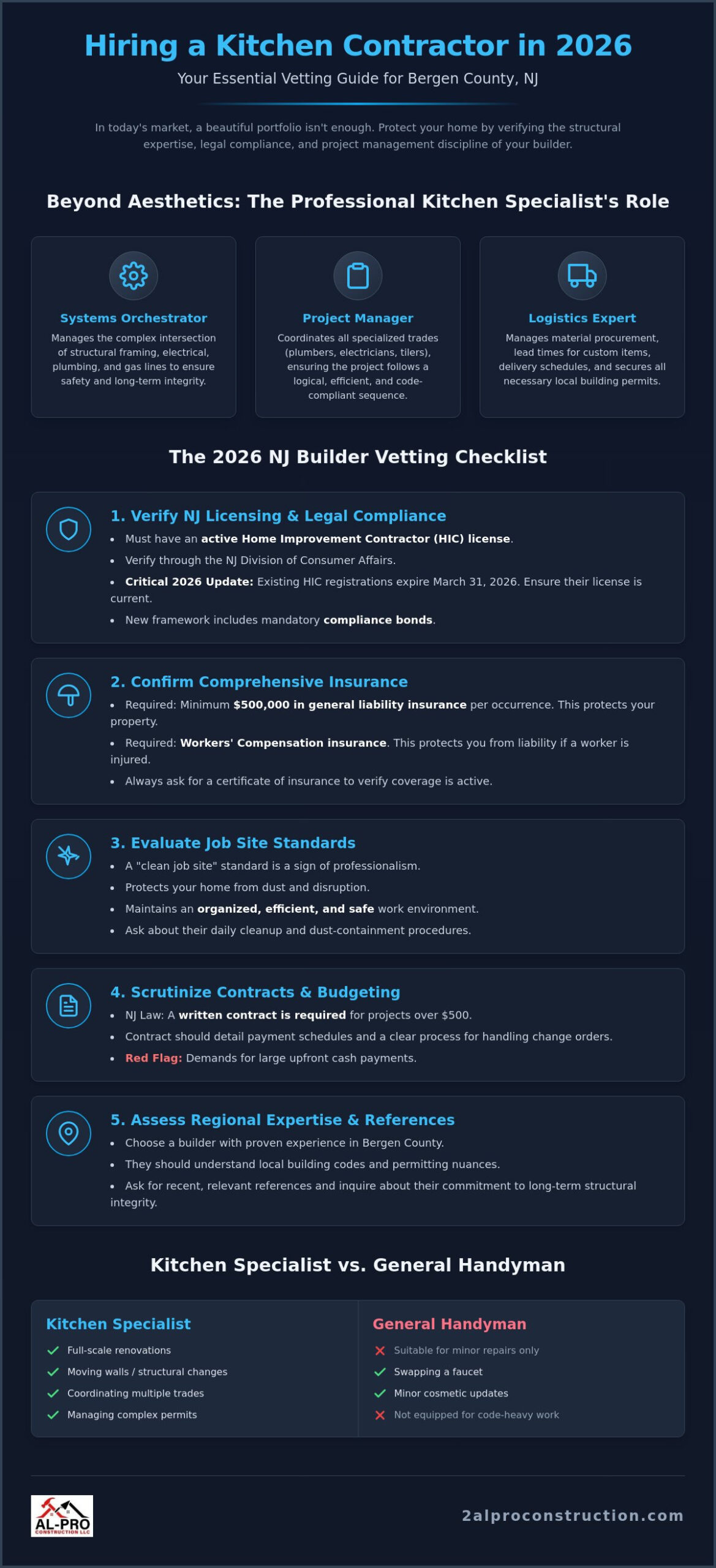
Every legitimate builder in the state must maintain an active Home Improvement Contractor (HIC) license through the NJ Division of Consumer Affairs. As of 2026, New Jersey has transitioned to a stricter licensing framework that includes mandatory compliance bonds and updated education requirements. You must verify that your contractor’s registration is current, as existing HIC registrations expire on March 31, 2026. Homeowners should also consult the FTC’s guide on red flags to watch for to recognize early signs of predatory practices, such as demands for cash-only payments or a refusal to provide a written contract for projects over $500.
Insurance coverage is equally vital. In New Jersey, contractors are required to carry a minimum of $500,000 in general liability insurance per occurrence. This protects your property if accidental damage occurs during the renovation. You should also confirm they carry workers’ compensation insurance. Without it, you could be held financially responsible for medical costs if a crew member is injured on your property. When you are ready to move forward, partnering with a local builder who maintains these professional standards ensures your project remains a safe investment.
Local Reputation and References
Longevity in the North Jersey area is a primary indicator of reliability. A kitchen contractor who has operated in towns like Oakland, Franklin Lakes, or Wyckoff for over 15 years has demonstrated the stability necessary to survive market shifts. This local roots approach often results in faster response times and a deeper understanding of regional building codes. Always ask for a physical business address in North Jersey rather than a P.O. Box. A permanent office suggests the company is a local fixture committed to the community’s professional standards.
When reviewing a portfolio, look for structural and aesthetic consistency across multiple projects. A high-quality builder will show you more than just finished “after” photos. They should be able to provide evidence of their “hidden” work, such as clean electrical rough-ins and organized plumbing layouts. If a contractor’s references only include projects from several years ago, it may be a sign of recent turnover or declining standards. Seek out homeowners who have completed renovations within the last 12 months to get an accurate picture of the contractor’s current project management and job site cleanliness.
Evaluating Craftsmanship and Job Site Standards
While high-definition portfolio photos are useful for inspiration, they don’t reveal the most critical aspect of a renovation: the quality of execution during the construction phase. A professional kitchen contractor manages the job site with the same precision they apply to the final trim work. This level of discipline ensures that the “hidden” components, such as plumbing rough-ins and electrical wiring, are installed to exceed local codes rather than just meet them. It’s helpful to review Federal Trade Commission advice on hiring contractors to understand why checking these operational standards is as vital as picking the right countertop material.
Managing subcontractors is another area where a general contractor’s expertise becomes visible. Every electrician, plumber, and tiler on the site must adhere to the same high standards set by the project manager. This oversight prevents the common “not my job” attitude that often leads to delays or structural oversights. A reliable builder provides regular updates through established communication protocols, ensuring you aren’t left wondering about the status of inspections or material deliveries. This transparency is a hallmark of a seasoned professional who values your peace of mind as much as the project’s outcome.
Order and Precision in Execution
A tidy workspace is not just about aesthetics; it’s a fundamental safety and efficiency requirement. We utilize specific dust mitigation strategies, such as HEPA filtration and zip-wall barriers, to protect the rest of your home during occupied renovations. When a job site is organized, errors are caught early and the timeline stays on track. This attention to detail extends to the final finishing work, where the alignment of cabinet doors and the precision of tile grout lines reflect the methodical approach taken from day one.
Structural Integrity Beyond the Cabinets
The foundation of a high-end kitchen is a level floor and square walls. Before any cabinetry is installed, we ensure the framing is perfect. For projects that involve structural changes or exterior modifications, we integrate our expertise as a masonry contractor Bergen County NJ to handle stone veneer or structural brickwork. This holistic approach ensures that the interior beauty of your kitchen is supported by a structurally sound exterior, preserving your home’s value for decades.
The Contract and Budgeting Checklist for 2026
A formal agreement is the foundation of a successful renovation. In New Jersey, state law requires a written contract for any home improvement project costing more than $500. This document is not merely a formality; it’s a detailed blueprint that defines the professional relationship between you and your kitchen contractor. A reliable builder will provide a transparent breakdown of costs, distinguishing between labor and material allowances to ensure you understand exactly where your investment is going. This clarity prevents the frustration of hidden fees that often plague less organized projects.
Payment structures are a primary indicator of a contractor’s stability. You should avoid any builder who demands a large upfront deposit before work begins. Instead, a methodical payment schedule should be tied to specific, verifiable milestones, such as the completion of demolition, the passing of rough-in inspections, or the delivery of cabinetry. This approach ensures that the project’s financial momentum matches its physical progress. Once the final tile is laid, your agreement should also specify a warranty period and a clear protocol for follow-up service to protect the long-term value of your renovation.
What Should Be in Your Written Agreement?
The scope of work must be exhaustive. It should cover everything from the initial demolition and debris removal to the final professional cleaning of the job site. Specificity is vital; your contract should list the brands and models of materials to be used to ensure the quality meets your standards. Furthermore, the agreement must include realistic start and completion dates. While a small buffer is normal in construction, having these dates in writing holds the team accountable to a disciplined timeline.
Budgeting for the Unexpected
Opening walls in older Bergen County homes often reveals unforeseen challenges, such as outdated plumbing or structural settling. We recommend maintaining a contingency fund of 10-15% of the total project cost to handle these realities without stress. Before finalizing your budget, it’s worth reviewing a detailed breakdown of the kitchen remodel cost North Jersey homeowners should anticipate in 2026, so you can plan for regional variables that national estimates routinely overlook. A professional “Change Order” process is essential here. This protocol ensures that if a structural issue is discovered, the solution and its cost are documented and signed by both parties before any additional work proceeds. This transparency prevents “scope creep” and maintains the integrity of your original budget. If you are ready to plan a kitchen renovation in Oakland NJ rooted in financial honesty, you can contact Al-Pro Construction to discuss a detailed estimate for your home.
Why Al-Pro Construction is the Right Choice for Your Kitchen
Selecting the right kitchen contractor is the most important step in ensuring your renovation is a success rather than a source of stress. Al-Pro Construction LLC has been a dependable presence in Bergen County for over 15 years, specializing in high-quality interior remodeling. Our reputation in Oakland and the surrounding towns is built on a foundation of structural integrity and professional project management. We don’t just build kitchens; we manage the entire lifecycle of the project with a focus on durability and order.
Our commitment to a clean job site is a core value that sets us apart. We understand the disruption a renovation causes, so we employ rigorous dust mitigation and organization strategies. This methodical approach ensures that your home remains a safe, livable environment while work is underway. By maintaining a tidy workspace, our craftsmen can focus on the technical details that define a high-end finish, from perfectly aligned cabinetry to flawless tile work.
Because our expertise includes both interior remodeling and structural masonry, we’re uniquely equipped to handle kitchens that require exterior modifications. Whether your project involves a home addition or a new stone facade, our team manages the structural demands with precision. This comprehensive skill set provides the peace of mind that comes from working with a local, family-owned business that understands the physical reality of North Jersey construction.
Our Master Craftsman Approach
We prioritize long-term value over aesthetic trends. Our approach involves direct owner involvement in project management, ensuring that every phase of construction meets our high professional standards. We take pride in being a local fixture, committed to the structural health of homes in our community. Every decision we make is rooted in years of hands-on experience and a no-nonsense dedication to quality. This focus on stability and precision is why Oakland and North Jersey homeowners trust us with their property.
Start Your 2026 Kitchen Transformation
Scheduling a local consultation is a straightforward process. During our first site visit, we’ll perform a detailed evaluation of your kitchen’s layout and structural needs. This allows us to provide a grounded, realistic estimate that accounts for the complexities of your specific home. We’ll walk you through the timeline and the material procurement process so you know exactly what to expect. If you’re looking for a partner who values precision and transparency, Contact Al-Pro Construction for a Reliable Estimate and take the first step toward a functional, high-end kitchen.
Securing the Future of Your Home Investment
A successful renovation depends on finding a partner who values order and structural integrity as much as you do. By following the 2026 vetting checklist, you can ensure your kitchen contractor meets the latest New Jersey licensing standards and maintains a disciplined job site. The best builders lead with transparency in their contracts and precision in their craftsmanship. This methodical approach protects your property from the common pitfalls of construction and ensures the long-term value of your home.
At Al-Pro Construction, we bring over 15 years of Bergen County experience to every project. As a licensed and insured NJ HIC, we specialize in clean-site remodeling to minimize the impact on your daily life. We take pride in our role as seasoned project managers who deliver high-end results through predictable, organized execution. You don’t have to navigate the complexities of a renovation alone. Schedule Your Bergen County Kitchen Consultation with Al-Pro Construction to begin planning your project with a team that values professional standards. We look forward to helping you build a kitchen that stands the test of time.
Frequently Asked Questions
How do I verify if a kitchen contractor is licensed in New Jersey?
You can verify a license by visiting the New Jersey Division of Consumer Affairs website and searching their Home Improvement Contractor database. In 2026, it is vital to check that the registration is active, as the state has transitioned to a more rigorous licensing framework. Always confirm that the contractor’s name matches their official filing and that they have met the new compliance bond requirements for the current year.
What is the typical timeline for a kitchen remodel in Bergen County in 2026?
A standard remodel usually requires eight to twelve weeks of active construction after the municipal permits are issued. This timeline accounts for demolition, utility rough-ins, inspections, and finish work. You should also factor in a four to six week lead time for custom cabinetry and high-end appliances during the planning phase. We provide a detailed schedule at the start of every project to keep the timeline predictable and organized.
Should I hire a separate designer or a design-build contractor?
Hiring a design-build kitchen contractor often streamlines the process by providing a single point of accountability for both aesthetics and structural execution. While some homeowners prefer separate designers, a specialized builder ensures that your design is physically feasible and stays within your structural budget. This integrated approach reduces communication errors and prevents design choices that might conflict with local building codes or structural requirements.
What insurance coverage should my kitchen contractor carry?
Your builder must carry at least $500,000 in general liability insurance per occurrence and a full workers’ compensation policy. These coverages protect you from financial responsibility if property damage occurs or if a crew member is injured on your site. Additionally, 2026 regulations require all NJ builders to maintain a tiered compliance bond. We recommend requesting a current certificate of insurance directly from the contractor’s agent before any demolition begins on your property.
How does Al-Pro Construction handle dust and mess during a remodel?
We utilize a “clean job site” standard that includes HEPA air scrubbers and floor to ceiling zip-wall barriers to isolate the construction zone. Our crew performs a thorough cleaning at the end of every workday to minimize dust tracking throughout your home. This methodical approach is designed specifically for families who remain in their houses during the renovation, ensuring your living space stays organized and habitable throughout the project.
Do I need a permit for a kitchen renovation in Oakland, NJ?
Yes, Oakland and most Bergen County municipalities require permits for any work involving structural changes, electrical wiring, or plumbing lines. Failing to secure these permits can lead to significant fines and complications when you eventually sell your property. We handle the entire permit application process and coordinate with local inspectors to ensure all work meets the professional standards and safety codes of the community.
What is a reasonable payment schedule for a kitchen remodeling project?
A professional schedule is based on project milestones rather than arbitrary dates. This typically begins with a modest deposit to secure your spot on the calendar, followed by payments after demolition, rough-in inspections, and cabinet delivery. The final payment should only be made after the project passes all local inspections and you have signed off on the finished work. This structure ensures that your financial investment always matches the physical progress on-site.
How often should I expect updates from my contractor during the project?
You should expect a project update at least two to three times per week, though daily communication is our standard during active construction phases. These updates should cover the status of material deliveries, upcoming inspections, and any necessary adjustments to the workflow. Clear communication prevents surprises and ensures you are always informed about the status of your home. We prioritize transparency to keep the renovation process as stress-free as possible.


