
How Much Will It Cost to Add a Bathroom? 2026 North Jersey Pricing Guide
Most homeowners assume that a bathroom’s square footage is the primary driver of its price tag, but in North Jersey’s unique housing stock, the location of your plumbing stack is often more influential than the size of the room itself. If you are asking how much will it cost to add a bathroom in Bergen County, you are likely balancing the need for more space with the fear of cost creep once the walls are opened. It’s natural to feel concerned about the logistics of basement drainage or the structural demands of an upper floor addition. You want a functional upgrade that increases your property value without turning your home into a chaotic, dusty job site for months.
We understand that peace of mind comes from predictable budgets and methodical execution. This guide provides a realistic, professional breakdown of what to expect for your 2026 project, from simple powder room conversions to full-scale master suite additions. We will explore regional cost factors, the return on investment you can expect for resale, and how to choose a contractor who respects your home’s integrity throughout the entire construction process.
Key Takeaways
- Learn why the proximity to your home’s existing “wet wall” is often more important for your budget than the actual square footage of the room.
- Understand the specific logistical requirements for different areas of your home, including concrete cutting for basements and structural reinforcement for upper floors.
- Get a professional breakdown of how much will it cost to add a bathroom based on current 2026 labor rates and your choice of standard or luxury finishes.
- Identify potential hidden expenses such as electrical panel upgrades and municipality-specific permit fees throughout Bergen County.
- Discover how methodical project management and clean job site practices can minimize disruption to your daily life during construction.
Breaking Down the Variables: What Drives Bathroom Addition Costs in 2026?
Homeowners often begin their research by looking at national averages, but the local reality in Bergen County is shaped by structural complexity and regional labor standards. When you ask how much will it cost to add a bathroom, the answer starts with the fundamental difference between a remodel and an addition. A remodel updates existing fixtures within an established footprint. An addition requires entirely new infrastructure, including structural support, electrical extensions, and complex plumbing tie-ins.
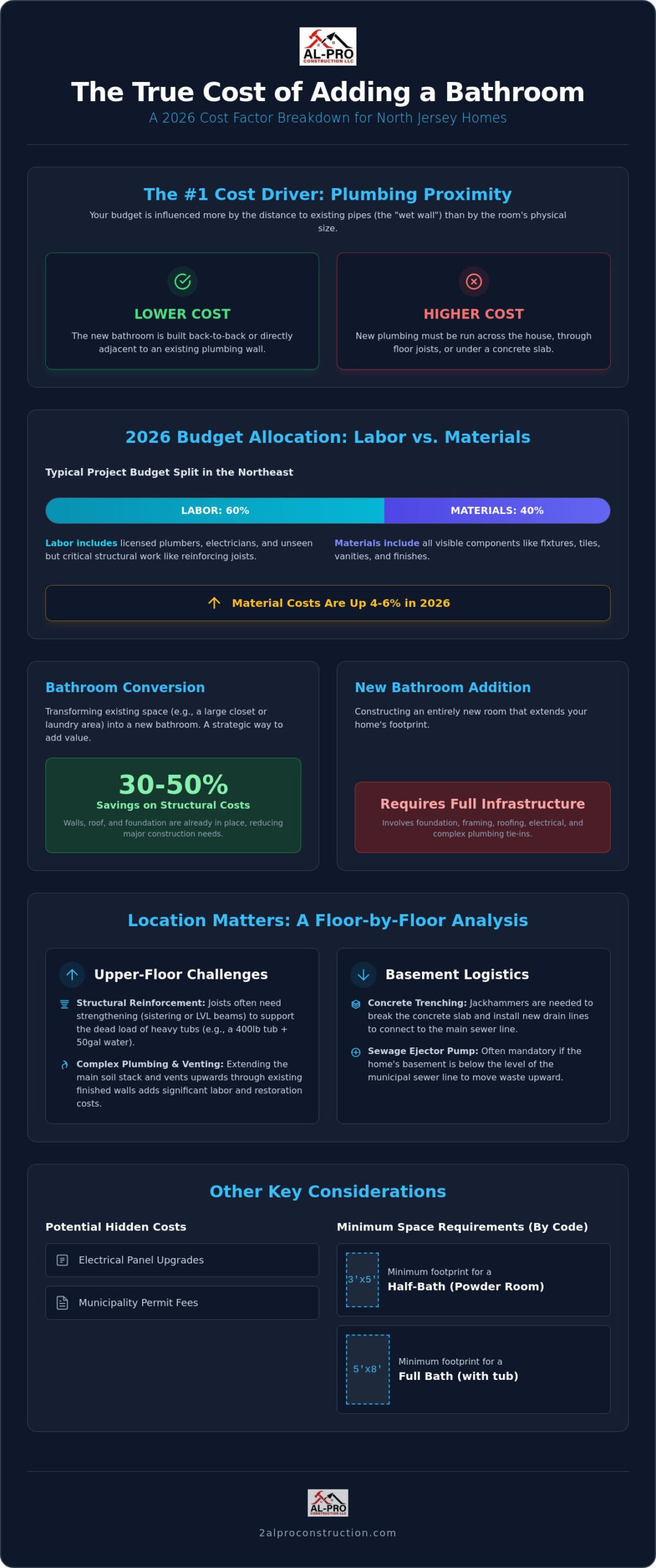
The “wet wall” is the primary cost driver for these projects. This is the wall containing the main soil stack and water supply lines. If your new bathroom sits back-to-back with an existing one, the plumbing logistics remain manageable. If the design requires running pipes across the house, through floor joists, or under a concrete slab, the labor hours increase significantly. This technical proximity dictates the baseline of your budget far more than the choice of a vanity or faucet.
Fixture density also plays a major role in the total investment. A small 40-square-foot bathroom requires the same number of rough-in connections as a larger 80-square-foot space. You aren’t just paying for the physical area; you’re paying for the concentration of mechanical systems. In 2026, the North Jersey market reflects a 4-6% increase in material costs compared to last year, making efficient design and material availability key factors in project timelines.
The Distinction Between Conversion and Addition
Converting a large closet or a section of a laundry room into a bathroom is a strategic way to add functional value. These projects typically save 30-50% on structural costs because the exterior walls and roof are already in place. However, even conversions must meet strict local building codes. A standard half-bath requires a footprint of at least 3 by 5 feet, while a full bath with a tub generally needs at least 5 by 8 feet to ensure proper clearance and accessibility. Homeowners working with tight footprints may also benefit from reviewing strategies for a small bathroom remodel in Bergen County to understand how layout innovations can maximize every available square inch.
Labor vs. Materials: The 2026 Ratio
Understanding how much will it cost to add a bathroom requires a look at the current labor-to-material ratio. The home improvement industry in the Northeast currently sees labor accounting for roughly 60% of a bathroom addition budget. This is due to the high demand for licensed plumbers and electricians in Bergen County. Beyond the visible finishes, a substantial portion of your budget covers unseen structural reinforcements. This includes sistering floor joists to support the weight of a new tub or upgrading subflooring to prevent grout cracks in heavy stone tile installations.
Location Matters: Basement Conversions vs. Upper-Floor Additions
The specific floor where you choose to build significantly influences the engineering requirements and the final quote. In Bergen County, the architectural style of your home, whether it is a 1950s split-level in Oakland or a century-old colonial in Ridgewood, dictates the technical approach. When calculating how much will it cost to add a bathroom, you must account for the physical path the new plumbing and ventilation will take to reach the existing main lines. A basement installation faces different mechanical hurdles than a second-story master suite expansion.
Second-floor additions often require structural joist reinforcement. Standard floor framing is designed for “live loads” like furniture and foot traffic, but it may not be sufficient for the “dead load” of a 400-pound cast iron soaking tub filled with 50 gallons of water. We often need to sister existing joists or install LVL beams to prevent floor sagging and tile grout cracking over time. Additionally, extending the soil stack upward through finished walls on the first floor adds a layer of restorative labor that a basement project avoids.
Basement Bathroom Logistics in North Jersey
Basement projects are frequently perceived as simpler, but they involve intensive labor. Because the waste lines are located beneath the concrete floor, we must use jackhammers to trench through the slab to reach the main sewer tie-in. If your home sits below the municipal sewer line, a sewage ejector pump system is mandatory to move waste upward. In areas of North Jersey with high water tables, we also evaluate existing sump pump systems to ensure the new bathroom doesn’t compromise your home’s moisture management. All these mechanical systems must comply with New Jersey’s Uniform Construction Code to ensure the installation is safe and legal.
Adding a Bathroom Above Grade
When adding a bathroom as part of a bump-out or a new home addition, matching the exterior is a priority. This involves sourcing siding and roofing materials that integrate seamlessly with your current exterior to maintain curb appeal. Beyond the shell, we must extend the HVAC ductwork to provide proper climate control and moisture venting. Without dedicated heating and cooling, the new space will struggle with humidity, leading to long-term maintenance issues. Understanding these structural demands helps clarify how much will it cost to add a bathroom in a way that preserves the integrity of your property.
Material Selection and Labor: Balancing Quality with Your Budget
Choosing materials for a new bathroom requires a balance between aesthetic preference and structural performance. While the average cost of a bathroom remodel provides a baseline for simple updates, a full addition requires higher-grade materials to support the new mechanical systems. Determining how much will it cost to add a bathroom involves more than just picking out a vanity. You must decide on the tier of finishes that fits your long-term goals for the property. Homeowners who want to see how material choices translate into real-world results can explore inspiring bathroom renovation North Jersey examples and planning strategies before finalizing their selections.
We categorize project finishes into three primary tiers to help homeowners prioritize their spending:
- Standard: Focuses on functional, reliable fixtures and ceramic tiling. These are ideal for basement guest baths or children’s bathrooms.
- Semi-Custom: Includes upgrades like comfort-height toilets, quartz countertops, and more intricate tile patterns.
- Luxury: Features high-end natural stone slabs, walk-in showers with frameless glass, and smart technology like heated floors or digital shower valves.
Our professional recommendation is to invest heavily in the components that are difficult to replace later. High-quality plumbing valves and waterproofing systems are essential. It is much easier to swap a decorative mirror in five years than it is to fix a leaking shower pan buried behind expensive tile. Prioritizing “invisible” quality ensures that your investment remains protected against water damage and structural settling.
The Cost of “Invisible” Quality
Durable construction starts with what you don’t see. We utilize advanced waterproofing systems like Schluter-Kerdi to create a completely sealed environment. These systems are superior to traditional cement board because they prevent moisture from reaching the wall studs. Additionally, modern NJ water conservation standards require high-efficiency fixtures. We also install anti-fracture membranes under floor tiles. This prevents the natural movement of your home from causing cracks in the grout or stone.
Fixture and Finish Tiers
Vanity selection often depends on your home’s layout. Stock vanities work for standard spaces, but many older Bergen County homes have unique alcoves that require custom-built cabinetry to maximize storage. Tiling labor also varies significantly based on the design. Large-format tiles require a perfectly level substrate, while mosaic patterns require meticulous alignment. Finally, never skimp on the exhaust fan. A high-cfm, quiet ventilation system is the only way to prevent mold growth and preserve your new finishes for the long term. Understanding these details clarifies how much will it cost to add a bathroom that stands the test of time.
The Hidden Costs of Adding a Bathroom in Bergen County
Budgeting for a new bathroom requires looking beyond the visible finishes like tile and vanities. In the North Jersey market, the logistical and regulatory requirements of your specific municipality often introduce expenses that aren’t apparent on a surface-level estimate. When homeowners ask how much will it cost to add a bathroom, they must account for the infrastructure needed to support modern fixtures. These hidden costs are essential for ensuring your project meets safety standards and maintains your home’s long-term value.
Electrical capacity is a frequent surprise for owners of older Bergen County homes. Many colonial-style properties still operate on 100-amp electrical service. Adding a modern bathroom with high-draw features like radiant floor heating or steam showers can push an old system to its limit. Upgrading your electrical panel to 200 amps is a common requirement to ensure your home can handle the new load safely. Additionally, homes built before 1978 may require professional lead or asbestos testing before demolition begins. This is a critical step for maintaining a clean and safe job site.
Navigating the NJ Permit Process
In 2026, permit fees for a bathroom addition in New Jersey typically range from $400 to $900 for mid-range projects. For higher-value luxury additions, these fees can reach between $900 and $1,800 depending on the specific municipality. Bergen County consists of over 70 municipalities, each with its own building department. You must provide professional drawings to secure plumbing and electrical sub-permits under the New Jersey Uniform Construction Code. We manage these milestones, including the rough-in and final inspections, to ensure your project is fully documented for future resale.
Structural and Utility Upgrades
Beyond the permits, the physical state of your existing utilities can impact the bottom line. If your home still has outdated galvanized piping, we recommend replacing those lines with copper or PEX during the “open wall” phase to prevent future leaks. We also evaluate your main water line to ensure it provides enough pressure for multiple bathrooms running simultaneously. If you are ready to move from a rough idea to a methodical plan, we invite you to contact Al-Pro Construction LLC for a professional bathroom remodeling consultation.
The “while we are at it” effect is another variable to watch. Once walls are opened, many homeowners decide to upgrade adjacent hallway lighting or refresh nearby closets. While these changes improve the overall flow of your home, they contribute to scope creep. Maintaining a disciplined focus on the initial project plan is the best way to keep your budget predictable and your completion date on schedule.
Planning Your Project with Al-Pro Construction LLC: From Estimate to Execution
Understanding how much will it cost to add a bathroom is a critical first step, but the value of your investment ultimately depends on the quality of the execution. At Al-Pro Construction LLC, we bring over 15 years of experience to North Jersey home remodeling. We focus on structural integrity and long-term durability rather than just aesthetic changes. Hiring a licensed and insured New Jersey general contractor is not just a legal requirement; it’s your primary protection against subpar workmanship and liability during the construction process.
We recognize that a bathroom addition is a major disruption to your daily routine. Our teams prioritize clean job sites to minimize dust and debris throughout the project. We use professional-grade floor protection and dust barriers to ensure the rest of your home remains habitable while we work. This methodical approach to order and precision is a core value of Al-Pro Construction LLC. We believe that a well-managed site leads to a more accurate and efficient build, reducing the stress often associated with home improvement.
Our Methodical Remodeling Process
Our process begins with a detailed consultation to align your vision with a realistic budget. We provide clear project timelines so you know exactly what to expect from demolition to the final inspection. Communication is a priority; we provide regular updates on milestones such as rough-in plumbing and electrical approvals. Every project concludes with a final walkthrough. This ensures every fixture and finish meets our professional standards before we consider the job complete and hand the space back to you.
Why Bergen County Homeowners Choose Al-Pro Construction LLC
Our expertise extends beyond interior remodeling. Because we also specialize in exterior masonry and home additions, we can handle the structural demands of a bathroom bump-out or a new footprint with ease. We have a deep understanding of local building codes in Oakland and across Bergen County, which streamlines the permit process and prevents costly delays. For those looking for a deeper dive into the planning phase, we recommend reviewing our Bathroom Remodeling: The Definitive 2026 Homeowner’s Reference Guide. This resource provides additional context for homeowners asking how much will it cost to add a bathroom while aiming for a high standard of physical quality.
Securing Your Investment with Professional Execution
Adding a bathroom is a complex structural undertaking that requires more than just a surface-level renovation. As we’ve explored throughout this guide, factors like the proximity to your home’s main soil stack and the need for structural reinforcement are the true drivers of your project’s budget. By prioritizing high-quality waterproofing and professional-grade mechanical systems, you ensure that your new space remains a functional asset for years to come. Understanding how much will it cost to add a bathroom is the first step toward a more comfortable and valuable property.
Al-Pro Construction LLC provides over 15 years of Bergen County remodeling experience to every project we undertake. As a licensed and insured NJ general contractor, we focus on methodical project management and the maintenance of clean, orderly job sites. We understand the specific building codes of North Jersey and work to minimize disruption to your daily routine during construction. We invite you to Request a Professional Bathroom Addition Estimate from Al-Pro Construction LLC to begin your home’s next chapter. Your property is in capable hands, and we look forward to building a space that meets your highest standards.
Frequently Asked Questions
Is it cheaper to convert a closet or build a bathroom addition?
Converting existing interior space like a large closet is significantly more cost-effective than building a new footprint. Because the foundation, exterior walls, and roof are already in place, homeowners often save 30% to 50% on structural costs. These projects focus your budget on plumbing tie-ins and interior finishes rather than heavy framing and masonry work.
How much value does a second bathroom add to a home in Bergen County?
Adding a second bathroom provides one of the highest returns on investment for North Jersey properties. Current 2026 data for the Mid-Atlantic region suggests an ROI of 60% to 70% for mid-range bathroom projects. Beyond the financial recovery, a second bath significantly increases the marketability of your home in competitive towns like Ridgewood or Paramus.
What is the most expensive part of adding a new bathroom?
Labor for skilled trades and the underlying plumbing infrastructure represent the largest portion of the budget. When homeowners ask how much will it cost to add a bathroom, they are often surprised that labor accounts for roughly 60% of the total. Running new waste lines and water supply pipes to a location far from the existing “wet wall” requires intensive technical expertise.
Can I add a bathroom to a basement without a floor drain?
Yes, you can install a basement bathroom by using a sewage ejector pump system. This system collects waste in a sealed pit and pumps it upward to meet the main sewer line. This approach requires trenching through the concrete slab to install the holding tank and pump, but it is a standard solution for North Jersey basements that sit below the municipal sewer level.
How long does a typical bathroom addition project take from start to finish?
A typical bathroom addition takes between 4 and 8 weeks once the construction phase begins. The timeline depends on the complexity of the plumbing and whether the project is a conversion or a bump-out addition. Factors such as municipality-specific inspection schedules and the lead times for custom materials like stone vanities also influence the final completion date.
Do I need a new building permit for a bathroom conversion in NJ?
Yes, any project that involves adding new plumbing, electrical lines, or structural changes requires a permit under the New Jersey Uniform Construction Code. Most Bergen County municipalities require separate sub-permits for building, plumbing, and electrical work. Securing these permits ensures the work is performed to safety standards and prevents legal issues during a future home sale.
Will adding a bathroom increase my property taxes in Bergen County?
Adding a bathroom will likely increase your property tax assessment because it enhances the value and functionality of your home. Local tax assessors in Bergen County view a new bathroom as a capital improvement. While the specific increase varies by town, the added resale value and daily convenience generally outweigh the incremental change in your annual tax obligation.
What are the minimum size requirements for a full bathroom in New Jersey?
A full bathroom with a tub or shower typically requires a minimum footprint of 35 to 40 square feet. A standard 5 by 8 foot layout is the most common configuration used to meet New Jersey building codes for fixture clearance. This size allows for the necessary spacing between the toilet, vanity, and bathing area while ensuring the room remains functional and accessible. Homeowners working within these tight dimensions may find additional guidance in our resource on small bathroom remodel Bergen County planning strategies to make the most of a compact layout.


