
The Ultimate Checklist for Deck Repair in North Jersey: A 2026 Safety Guide
A deck in North Jersey is not just a platform for summer gatherings; it is a structural assembly constantly battling some of the harshest freeze-thaw cycles in the Northeast. If you are currently looking into deck repair north Jersey, you’re likely concerned that recent ice or the humid summer air has caused more than just surface fading. It is natural to feel uneasy when you cannot tell if a soft spot near the stairs is a simple staining issue or a sign of deep structural rot that could compromise your family’s safety.
We believe that every homeowner deserves clarity and peace of mind regarding the integrity of their property. This guide provides a methodical checklist to help you identify critical safety risks while adhering to the 2026 New Jersey Uniform Construction Code. You will learn how to evaluate everything from 36-inch guardrail heights to the stability of your frost footings. We provide the technical knowledge you need to distinguish between minor maintenance and essential structural work, giving you the confidence to choose the most responsible path for your home’s safety and long-term value.
Key Takeaways
- Perform a systematic inspection of your deck’s surface and hardware to identify splintering or rusted fasteners before they become safety hazards.
- Identify structural vulnerabilities in the ledger board and flashing that often lead to hidden rot within your home’s frame.
- Evaluate how the local freeze-thaw cycle impacts materials and why professional deck repair north Jersey is essential for maintaining long-term stability.
- Apply the 40% Rule to decide between repairing surface boards or investing in a full replacement based on the condition of the underlying joists.
- Gain insight into a methodical restoration process that emphasizes 2026 building codes and organized project execution.
The Homeowner’s Diagnostic Checklist for Deck Repair
Maintaining a safe outdoor space begins with a systematic evaluation of physical components. Understanding basic deck construction principles allows you to spot issues before they escalate into structural failures. When considering deck repair north Jersey, your first task is to separate cosmetic wear from genuine safety hazards. A deck that looks weathered might only need a fresh coat of stain, while a deck that looks sturdy could be hiding dangerous rot in its ledger board or joists.
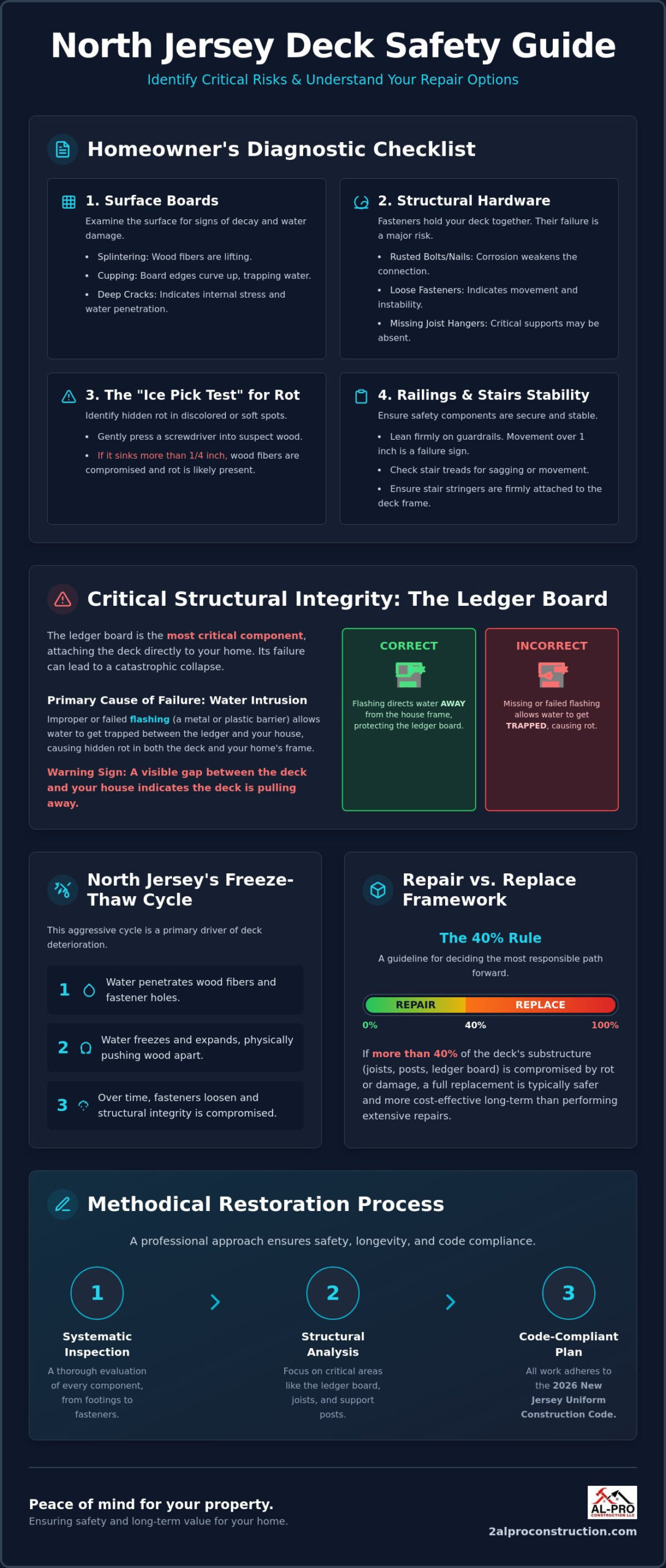
Start your inspection by examining the surface boards. Look for splintering, cupping, or deep cracks that run parallel to the wood grain. Cupping occurs when the edges of a board curve upward, creating a basin that traps water and accelerates decay. Next, shift your focus to the structural hardware. Check for rusted bolts, loose nails, or missing joist hangers. If you see orange or reddish-brown staining around metal fasteners, the hardware is likely corroding and losing its grip on the timber. This is a critical point for deck repair north Jersey homeowners should not ignore, as hardware failure is a leading cause of deck collapse.
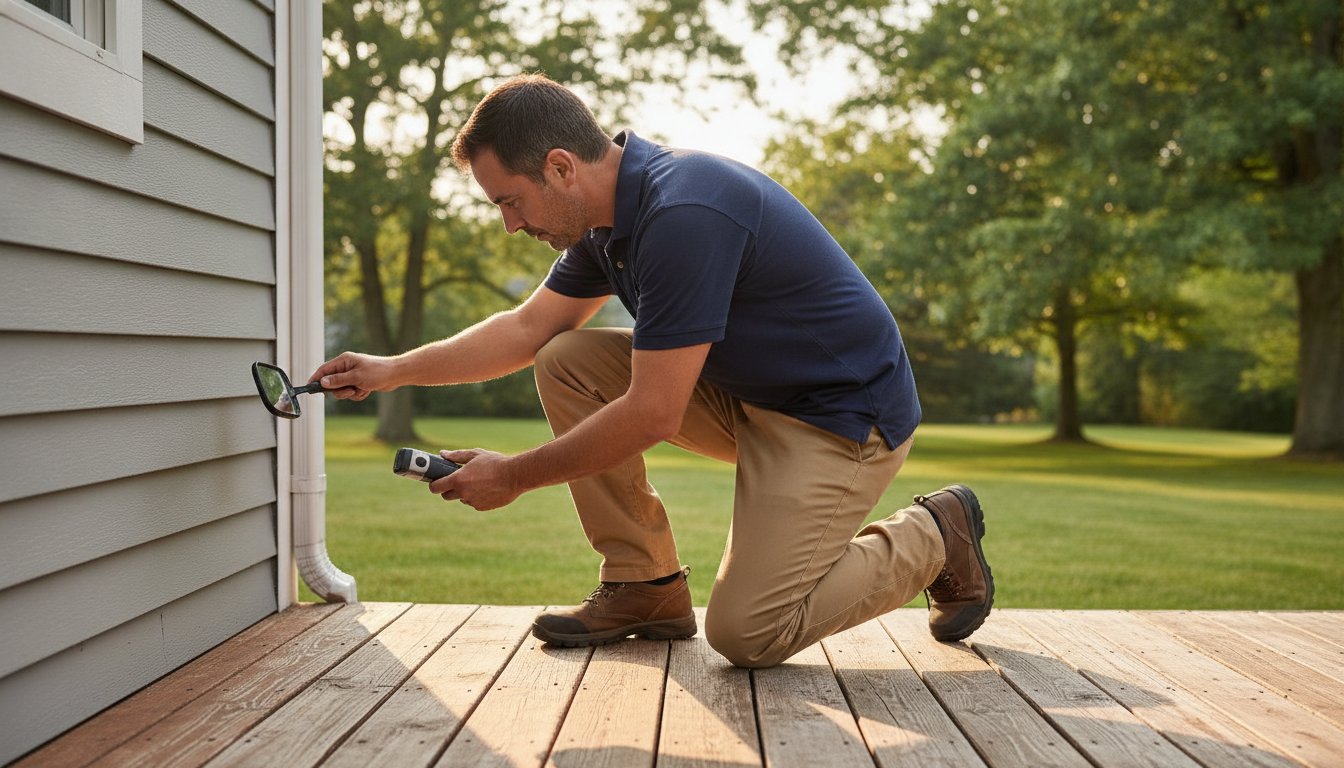
To identify hidden wood rot, use the “Ice Pick Test.” Take a small screwdriver or ice pick and gently press it into any dark or discolored spots on the wood, especially near the ground or where two boards meet. If the tool sinks in more than a quarter-inch without much resistance, the wood fibers have broken down. This biological rot requires immediate professional attention. Finally, test the stability of your railings and stairs. Lean firmly against the guardrails to check for “give” or wobbling. If the railing moves more than an inch, the posts are likely loose or the wood at the base is compromised. Check stair treads for sagging and ensure the stringer, the diagonal support for the steps, is still firmly attached to the deck frame.
The Visible Signs of North Jersey Weather Damage
The 2026 freeze-thaw cycle in our region is particularly aggressive. When water enters wood fibers and freezes, it expands, physically pushing the wood apart and loosening fasteners over time. Look for “alligatoring” in your deck’s finish, which appears as a pattern of small, interconnected cracks. This indicates the stain is no longer providing a waterproof seal. While graying wood is often just a result of UV exposure, dark, soft patches are signs of dangerous rot that compromise structural integrity.
The “Five-Minute Walkaround” Safety Protocol
Begin your safety check at the ground level by inspecting the footings. Look for signs of shifting or frost heave, where the concrete piers have moved due to soil expansion. Walk across the deck to check the “bounce.” Excessive deflection in the joists suggests they may be undersized or weakened by age. As you walk, document any damage with your phone. Clear photos of rusted hardware or rotted joists help your contractor provide a more accurate and methodical estimate for the necessary repairs.
Critical Structural Integrity: The Ledger Board and Joists
While surface boards are the most visible part of your outdoor space, the underlying frame determines the safety of the entire structure. The ledger board is the most critical component in this system. It’s the heavy-duty beam that attaches the deck directly to your home’s rim joist. When performing a thorough assessment of these hidden elements as part of a deck repair north Jersey, you must ensure this connection is secure. If the ledger board fails, the entire deck can pull away from the house, leading to a catastrophic collapse. This isn’t just an aesthetic concern; it’s a fundamental requirement for structural stability.
Water management is the primary factor in ledger board longevity. Flashing failure occurs when the metal or plastic barrier designed to shed water away from the house is missing, damaged, or improperly installed. In many Bergen County homes, improper water shedding leads to house-frame rot. When water becomes trapped behind the ledger board, it creates a persistent damp environment that eventually rots the house’s internal framing. This results in repairs that are far more complex and expensive than simple deck maintenance. Our team at Al-Pro Construction focuses on these structural details to ensure your exterior renovation is built to last.
Why Ledger Board Failure is a Major Safety Risk
A “pulling” deck is one of the most dangerous signs of structural failure. If you notice a visible gap between your house siding and the deck
North Jersey Climate Impact on Decking Materials
The climate in North Jersey presents a unique set of challenges for any outdoor structure. From the humid, high-UV summers to the freezing, snow-heavy winters, your choice of material directly dictates the lifespan of your deck. Pressure-treated lumber remains a popular choice in Oakland, NJ, because it’s cost-effective and structurally robust. However, this wood is highly susceptible to the moisture levels found in Bergen County. Without consistent care, the natural fibers absorb water during the spring rains and then crack during the summer heat. This cycle often leads to a need for deck repair north Jersey as the wood begins to warp or split under environmental stress.
Composite decking has become a standard alternative for homeowners seeking to minimize maintenance. Modern materials like Trex are engineered to handle the intense summer sun without the splintering associated with natural timber. While these products resist biological rot, they aren’t entirely immune to the environment. Older generations of composite can experience fading or “thermal expansion,” where the boards grow and shrink significantly as temperatures fluctuate. This movement can loosen fasteners or cause the deck surface to become uneven if it’s not installed with the correct spacing and hardware.
Proximity to major highways and the frequent use of winter de-icing chemicals also play a role in material degradation. Road salt and salt-laden air can accelerate the oxidation of metal components. When salt settles on your deck, it draws moisture into the wood and reacts with the metal fasteners. This environmental factor is why we emphasize the use of corrosion-resistant materials for every project we manage in the region. Choosing the right materials now can reduce the frequency of deck repair north Jersey in the future.
Wood vs. Composite: The 2026 Repair Outlook
Natural wood demands a disciplined maintenance schedule. To prevent Bergen County humidity from causing deep-seated rot, you must apply a high-quality sealant at least every two years. If you skip this step, the repair costs for replacing rotted joists or surface boards will quickly escalate. For a deeper analysis of these options, consult our guide on the best decking material for New Jersey climate to help with your long-term planning. This resource helps you understand the functional value of each material before you commit to a restoration project.
Hardware Corrosion in Local Environments
The structural integrity of your deck relies on the quality of its fasteners. We prioritize stainless steel or hot-dipped galvanized hardware because standard steel quickly fails in our damp climate. Chemical reactions often occur between the copper found in pressure-treated wood and certain types of hardware, leading to “bleeding” or dark streaks on the timber. Galvanic corrosion is the silent killer of North Jersey deck frames, occurring when two dissimilar metals react in the presence of moisture to weaken the very bolts holding your deck together.
The Repair vs. Replace Decision Framework
Deciding whether to invest in a targeted repair or commit to a full replacement is a calculation of both safety and long-term financial value. While many homeowners prefer the lower upfront cost of a fix, structural integrity must remain the primary factor. A pragmatic benchmark we use is the 40% Rule. If the estimated cost of a deck repair north Jersey exceeds 40% of the price of a completely new build, the investment typically favors a full replacement. This is because a new structure provides a reset on the lifespan of every component, from the footings to the railings, ensuring you aren’t simply patching a failing system.
The condition of the frame is the ultimate deciding factor. If your previous inspections revealed that the joists are rotted or the ledger board is compromised, spending money on new surface boards is a waste of resources. You cannot safely anchor new decking to a frame that has lost its structural density. Conversely, if the frame is pressure-treated lumber in good condition, a professional “re-skinning” can save your investment while providing the aesthetic of a brand-new deck. In many cases, old decks in Bergen County also fall short of the 2026 safety standards for railing height and stair width, making a full replacement the only way to bring the property into modern code compliance. Homeowners who want to maximize their outdoor investment often explore options beyond a simple deck, and working with a covered porch builder Bergen County can provide a durable, all-season alternative that meets the latest New Jersey Uniform Construction Code requirements.
When a Professional Deck Repair is the Right Choice
Repair is the responsible path when the issues are isolated and the primary structure remains sound. Replacing a few splintered or cupped floorboards can prevent trip hazards and extend the life of the remaining deck. Similarly, reinforcing a loose railing or replacing worn stair treads are routine maintenance tasks that protect your family without the need for a total overhaul. If you are unsure about the state of your sub-structure, consulting a deck builder Bergen County NJ for a formal structural audit is a prudent first step. For a methodical assessment of your project, you can contact Al-Pro Construction to schedule a professional evaluation.
Signs Your Deck is Beyond Repair
Some defects are too deep for simple fixes. Widespread structural rot in the main support posts or the primary beams indicates that the deck’s load-bearing capacity is gone. Major shifting in the concrete footings, often caused by improper drainage or the North Jersey frost-heave cycle, also necessitates a rebuild. Beyond safety, a full replacement allows you to upgrade to modern composite materials that handle local humidity better. A new project also significantly improves your home’s curb appeal and property value, offering a fresh, orderly look that a repaired older deck cannot match.
The Al-Pro Approach to Reliable Deck Restoration
Al-Pro Construction LLC has spent over 15 years managing exterior renovations across Oakland and Bergen County. We approach every project with a master craftsman’s perspective, which means we prioritize structural integrity over fast cosmetic updates. When you hire us for deck repair north Jersey, you’re working with a team that values precision and long-term durability. We understand that a deck is a significant component of your home’s exterior system. It must function in harmony with your siding, masonry, and the surrounding landscape to provide lasting value.
Our project management style is methodical and orderly. We maintain clean job sites because we respect your property and believe that a disciplined workspace leads to superior physical results. This methodical approach to deck repair north Jersey ensures that every bolt is tightened to spec and every board is aligned perfectly. We don’t just fix the surface; we ensure the underlying frame is capable of supporting your family for years to come. Our reputation is built on dependable results and the peace of mind that comes from a well-executed, orderly project.
Professional Inspection and Transparent Estimates
An Al-Pro site visit is a thorough and grounded process. We examine every element of the structure, from the critical ledger board connection to the depth and stability of the footings. This allows us to provide a detailed, declarative project plan that outlines exactly what needs to be done. You won’t find hidden construction costs in our estimates because we identify the necessary work upfront. We focus on selecting weather-resistant materials specifically suited for the North Jersey climate, ensuring that our repairs withstand the aggressive freeze-thaw cycles common in our region.
Expanding Your Outdoor Living Space
Sometimes a repair reveals an opportunity to enhance your home’s functionality and curb appeal. We often collaborate with homeowners to transform a standard deck into a comprehensive, multi-tier outdoor living area. By integrating our expertise as a patio builder Bergen County NJ, we can create a seamless transition between your elevated deck and new masonry or paver features. This holistic approach ensures that your exterior renovations are aesthetically consistent and structurally sound from the ground up.
Working with a licensed and insured general contractor provides the assurance that your property is in capable, experienced hands. We take pride in our regional familiarity and our commitment to the professional standards of the communities we serve. Contact Al-Pro Construction LLC today to schedule your 2026 deck safety inspection and ensure your outdoor space is ready for the upcoming season.
Securing Your Outdoor Investment for the 2026 Season
Ensuring the safety of your deck requires a transition from simple visual checks to a methodical structural assessment. By understanding the critical role of the ledger board and recognizing how the North Jersey freeze-thaw cycle stresses wood fibers, you can make informed decisions about your property. Whether you are addressing minor surface wear or navigating the 40% Rule to decide on a full replacement, prioritizing structural integrity is the only way to achieve long-term peace of mind. A well-maintained deck is a functional extension of your home that should provide safety and satisfaction for years to come.
Al-Pro Construction LLC brings over 15 years of Bergen County experience to every project. As a licensed and insured NJ general contractor, we specialize in structural integrity and masonry, ensuring your exterior renovations meet the highest professional standards. We invite you to Schedule Your Professional Deck Inspection with Al-Pro Construction to identify potential risks before your next gathering. Our team is ready to provide the expert guidance needed for your next deck repair north Jersey. Take the first step toward a safer, more durable outdoor space today.
Frequently Asked Questions
How do I know if my deck boards are rotted or just dirty?
Perform the ice pick test by pressing a small screwdriver into any dark or discolored spots on the wood. If the tool sinks easily into the fibers without resistance, the wood is rotted and needs replacement. Surface dirt, algae, and mildew can usually be scrubbed away with a deck cleaner, but rot indicates a permanent breakdown of the structural integrity of the timber.
Is it worth repairing a 20-year-old wood deck in North Jersey?
The decision depends entirely on the condition of the underlying frame. If the joists and support posts remain structurally sound, a professional can often extend the deck’s life by replacing only the surface boards and railings. However, if the frame shows widespread rot or fails to meet 2026 safety standards, a full replacement is a more responsible investment for your home’s long-term value.
Do I need a permit for deck repairs in Bergen County?
New Jersey enforces a statewide Uniform Construction Code that requires permits for most structural deck work. This includes replacing railings, stairs, or any work on a deck attached to the house. While minor cosmetic board replacements might not always require a permit, it’s best to verify with your local building department to ensure your project complies with the 2021 International Residential Code.
Can I replace just the floorboards and keep the old frame?
You can replace just the floorboards if the frame is structurally intact and free of biological rot. This process is a common way to upgrade to composite materials without the cost of a full rebuild. A professional must audit the joist spacing and ledger board connection first to ensure the existing frame can safely support the weight and expansion of the new surface.
How much does the average deck repair cost in North Jersey?
Costs for a deck repair north Jersey vary based on the scope of the project and the materials selected. Minor hardware replacements or isolated board fixes are less intensive than structural ledger board or joist repairs. Factors such as deck height, permit requirements, and the current condition of the frame all influence the final investment. We recommend a professional site visit to receive an accurate project plan.
What is the best time of year to schedule deck repairs?
Early spring and fall are the ideal times to schedule your project. These seasons offer the stable temperatures and lower humidity levels necessary for wood to dry correctly after staining or for new materials to settle. Completing repairs before the peak summer season ensures your outdoor space is safe and ready for use when the weather is most favorable for gatherings.
How can I prevent my deck from rotting in the NJ humidity?
Consistent maintenance is your primary defense against the local climate. Apply a high-quality water-repellent sealant at least every two years to prevent moisture from entering the wood fibers. Ensure there is adequate ventilation beneath the structure to allow damp soil to dry. Clearing debris from between the board gaps also prevents water from trapping against the joists and causing premature structural decay.
Are composite decks completely maintenance-free?
Composite decks are low-maintenance but not entirely maintenance-free. While these materials don’t require the staining or sealing associated with natural wood, you must still wash the surface periodically to prevent mold and mildew growth. You should also continue to inspect the structural hardware and fasteners, as metal components remain subject to environmental stress and corrosion even when the surface boards are synthetic.


