

Best Decking Material for New Jersey Climate: A 2026 Homeowner’s Guide
In New Jersey, your deck must survive a 100-degree temperature swing between the peak of July and the depths of February. Most homeowners understand the frustration of watching a traditional wood deck splinter under the summer sun or warp after a heavy winter freeze. It’s a significant investment, and you shouldn’t have to spend your weekends sanding and staining just to keep the boards from failing. Choosing the best decking material for New Jersey climate is the only way to ensure your outdoor space remains structurally sound and comfortable for decades.
We provide a professional look at which materials actually withstand our state’s unique humidity and freeze-thaw cycles. This guide examines the long-term value of composite and PVC options, the reality of heat-mitigating technology for those scorching July afternoons, and how current 2026 building codes impact your project. You will gain the technical clarity needed to build a low-maintenance deck that increases your property value and stands up to the Garden State’s toughest seasons.
Key Takeaways
- Learn why the “100-degree delta” in our local weather makes choosing the best decking material for New Jersey climate essential for long-term structural integrity.
- Compare the upfront savings of pressure-treated lumber against the long-term durability and reduced maintenance requirements of modern composite and PVC options.
- Understand the technical differences between capped composite and cellular PVC to determine which material best resists the high humidity and fungal growth common in Bergen County.
- Discover how your property’s specific sun exposure and family usage patterns should dictate your final material selection for optimal comfort and performance.
- See why professional installation and adherence to the 2021 International Residential Code are just as critical as the boards you choose for a safe, lasting investment.
The New Jersey Climate Challenge: Why Your Deck Faces Unique Stress
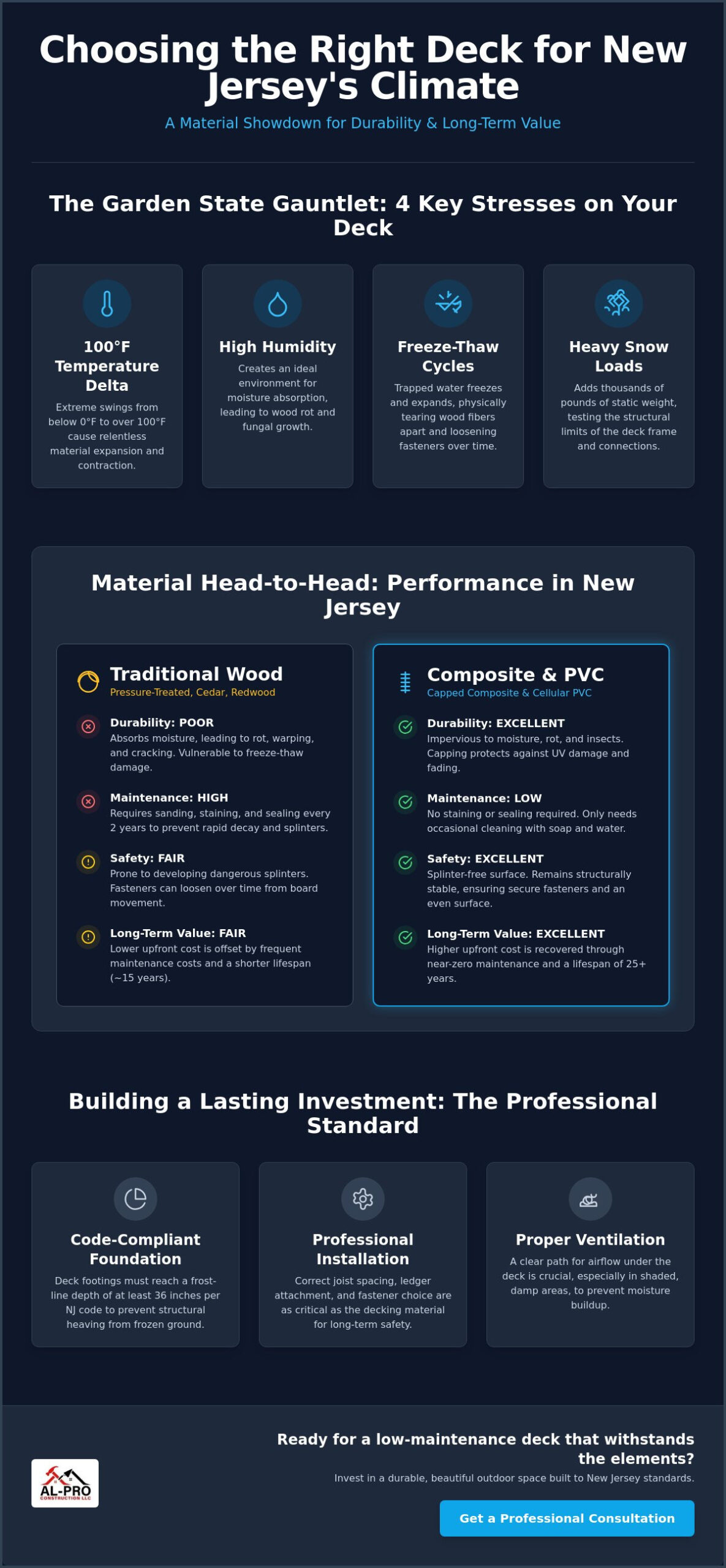
North Jersey homeowners deal with a “100-Degree Delta” that few other regions experience. In February, temperatures frequently drop below zero; by July, they often hit 100 degrees with stifling humidity. This isn’t just a matter of personal comfort. It is a relentless structural stress test for any outdoor installation. Finding the best decking material for New Jersey climate requires understanding these physical stressors and how they interact with different building components.
High humidity levels in Bergen County create an ideal environment for wood-destroying fungi. Natural wood fibers act like a sponge, pulling moisture from the air and trapping it within the grain. This saturation leads to internal rot that often goes unnoticed until the structural integrity is compromised. Selecting the best decking material for New Jersey climate means looking for products that don’t absorb this seasonal moisture or provide a food source for organic decay.
Humidity and Moisture Retention in North Jersey
In towns like Oakland or Franklin Lakes, many properties feature dense tree cover and shaded backyards. These wooded areas create moisture-trapping micro-climates where the sun cannot easily dry out deck boards after a storm. This persistent dampness accelerates the breakdown of organic deck fibers. We’ve found that proper ventilation under the deck is just as important as the surface material itself. Without a clear path for airflow, even high-quality lumber will eventually succumb to the humid continental climate of North Jersey.
The Freeze-Thaw Cycle and Structural Integrity
The freeze-thaw cycle is the primary enemy of deck stability in our region. When water enters wood pores or tiny cracks in a board and freezes, it expands with incredible force. This physical expansion literally tears wood grains apart over several seasons. It also puts immense pressure on structural fasteners. As the wood expands and contracts, screws and bolts can loosen, leading to “board crawl” where the deck surface becomes uneven or dangerous.
To mitigate these risks, many homeowners choose Wood-plastic composites (WPCs) or cellular PVC, which do not absorb the water that fuels this destructive cycle. Furthermore, New Jersey building codes require deck footings to reach a frost-line depth of at least 36 inches. This ensures the ground’s natural expansion doesn’t heave the entire structure out of the soil. Stability is a result of methodical planning and respecting the physical reality of our local winters.
Finally, heavy snow loads add thousands of pounds of pressure to a deck frame. The 2021 International Residential Code (IRC) provides strict guidelines for joist spacing and ledger attachment to prevent structural failure under these loads. A well-built deck must be engineered to handle the weight of a North Jersey blizzard without sagging or pulling away from the home’s foundation.
Traditional Wood Decking: Realities for NJ Homeowners
Wood remains a popular choice for its classic aesthetic, yet it requires a realistic understanding of long-term maintenance. In our local environment, natural lumber is constantly fighting moisture absorption and thermal expansion. While some homeowners consider it the best decking material for New Jersey climate due to its lower initial cost, the biennial “stain and seal” cycle can quickly become a burden. Without this consistent attention, the structural integrity of the boards will decline long before the frame does.
Cedar and Redwood are often cited as premium softwoods because of their natural tannins which resist rot. However, even these species struggle with the intense UV exposure found in North Jersey backyards. Over time, the sun bleaches the fibers, leading to a greyed appearance and surface cracking. If you don’t apply a high-quality UV-inhibiting sealer every 24 months, the wood will lose its structural oils and become brittle under the weight of winter snow loads.
Pressure-Treated Wood: Value vs. Longevity
Pressure-treated (PT) lumber is the industry standard for budget-friendly projects. It’s chemically forced with preservatives to resist insects, but it isn’t immune to physical weather damage. During intense New Jersey heat waves, the rapid evaporation of moisture causes the wood to shrink and pull. This leads to “checking,” which are deep cracks along the grain that eventually cause painful splinters. In Bergen County, a PT deck has an expected lifespan of about 15 years, but this assumes the owner is diligent about sealing the surface to prevent water from reaching the core of the boards.
Hardwood Decking: The Premium Natural Choice
For those who want the look of real wood without the frequent replacement cycle of softwoods, tropical hardwoods like Ipe and Garapa are excellent alternatives. These species are incredibly dense, making them nearly impervious to the wood-destroying fungi and insects common in our region. Ipe is a Class A fire-rated material comparable to concrete, offering a level of safety and durability that standard lumber cannot match.
While these hardwoods are durable, they aren’t maintenance-free. If left untreated, they will fade to a uniform silver patina. Maintaining the original deep brown hue requires a specialized oil treatment once a year. If you’re weighing the costs of these premium materials, our team can provide a detailed assessment of how professional deck installation ensures these heavy, dense boards are fastened correctly to prevent warping. Choosing the best decking material for New Jersey climate often involves balancing this desire for natural beauty with the reality of the labor required to preserve it.
Composite and PVC Decking: The Low-Maintenance Solution
Synthetic materials have redefined the standards for outdoor living in the Northeast. While natural wood was once the primary option, many homeowners now view synthetic boards as the best decking material for New Jersey climate due to their engineered durability. We typically categorize these products into two groups: capped composite and cellular PVC. Capped composite consists of a blend of wood fibers and recycled plastics, protected by a hard polymer shell. Cellular PVC is 100% plastic, containing no organic material whatsoever. Both options eliminate the need for the exhausting sanding and staining cycles discussed in the previous section.
A frequent concern with synthetic decking is heat retention during July. Early iterations of these products could become uncomfortably hot under direct sunlight. However, modern manufacturers have introduced heat-reflective technology. These “cool-deck” boards use specialized pigments to bounce solar energy away from the surface. This advancement ensures that even a dark-colored deck remains comfortable for bare feet during a typical New Jersey heat wave.
Composite Decking Performance in NJ Winters
The freeze-thaw cycles that destroy wood grains have little effect on high-quality composite. Because the boards are capped with a protective layer, moisture cannot penetrate the core. This prevents the internal expansion that leads to splintering and structural cracking during deep freezes. Safety is another critical factor. We look for materials with high slip-resistance ratings to handle the following conditions:
- Icy buildup during January and February snowstorms.
- Slick surfaces caused by heavy spring rain.
- The accumulation of salt and brine tracked onto the deck from nearby walkways.
Cleaning these surfaces after a North Jersey winter is straightforward. A simple wash with soap and water usually removes the residue left behind by melting snow and ice-melt products.
PVC Decking for Pools and High-Moisture Lots
In heavily wooded areas of Bergen County, such as Oakland or Franklin Lakes, shaded backyards often struggle with persistent dampness. These micro-climates are breeding grounds for mold and mildew on organic surfaces. Cellular PVC is the superior choice for these environments because it lacks the wood fibers that fungi use as a food source. It’s also the ideal material for homes with swimming pools. It withstands constant splashing and exposure to pool chemicals without staining or warping. While PVC is lighter than composite, it has a higher rate of thermal expansion. This requires a professional approach to structural framing and fastening to ensure the boards remain secure as temperatures fluctuate.
When selecting your boards, look for manufacturer guarantees that cover fading and staining for 25 to 50 years. These warranties provide a level of long-term security that natural wood simply cannot match in our volatile climate.
Selection Framework: Choosing Based on Your Property
Every property in Bergen County presents a unique set of environmental challenges. Choosing the best decking material for New Jersey climate requires a methodical assessment of your lot’s specific conditions. A south-facing yard in Paramus deals with relentless UV exposure that can bleach and crack organic materials, whereas a shaded lot in Ridgewood faces persistent moisture and algae growth. We categorize these factors into a selection framework to help you make an informed investment.
Usage patterns also dictate material choice. High-traffic family decks need the scratch resistance found in capped composites. If you’re designing a quiet aesthetic retreat, you might prioritize the tactile feel of natural hardwoods. We also ensure the material complements the architectural style of your home, whether it’s a classic colonial or a modern renovation. A professional builder considers how the deck integrates with the existing structure to ensure a cohesive look.
The “Total Cost of Ownership” Calculation
A common mistake is focusing solely on the initial installation price. A pressure-treated wood deck requires power washing, sanding, and staining every two years to remain safe and attractive. When you factor in the cost of professional labor and high-quality sealants, the financial picture changes significantly. While wood is cheaper upfront, labor for maintenance in NJ often closes the price gap within 7 years.
Beyond maintenance, the choice of material impacts the resale value of your North Jersey home. Potential buyers in our region often view a well-maintained composite deck as a premium feature because it guarantees them a low-maintenance lifestyle. This makes synthetic materials a more stable long-term asset compared to wood, which may show signs of structural aging by the time you decide to sell.
Environmental and Site Factors
For homes on heavily shaded lots, “green deck” syndrome is a persistent problem. Algae and mold thrive on the organic components of wood and early-generation composites. In these environments, cellular PVC is often the best decking material for New Jersey climate because it contains no wood fibers for organic growth to cling to. Conversely, if your yard has no tree cover, we recommend selecting lighter colors that won’t absorb excessive heat during the peak of summer.
To further combat heat and UV exposure, many homeowners opt to install a high-quality aluminium pergola uk, which provides a durable, low-maintenance shade solution that perfectly complements a modern synthetic deck.
Some homeowners find that a combination of materials works best for their lifestyle. For example, you might choose a raised composite deck for dining and a stone surface for a fire pit area. For homeowners looking for a more permanent ground-level solution, check out our masonry and patio options for hybrid outdoor living spaces. If you’re planning a complete outdoor retreat that includes both a deck and a patio, working with an experienced patio builder Bergen County NJ ensures your materials and base preparation are properly matched to our local freeze-thaw conditions. If you’re ready to start your project, request a professional consultation with our team to review your site-specific needs.
Professional Installation: The Al-Pro Construction Standard
Selecting the best decking material for New Jersey climate is only half the battle. Even the most expensive PVC or composite boards will fail prematurely if they are fastened to a rotting or unstable frame. At Al-Pro Construction LLC, we focus on the structural substructure first. We have spent over 15 years navigating the specific building codes of Bergen County, ensuring every project meets the 2021 International Residential Code (IRC) standards for safety and longevity. Our team treats the frame with the same level of care as the visible surface.
Professionalism extends beyond the physical build. We maintain clean job sites and provide reliable project management to minimize the disruption to your daily life. You’ll receive clear communication throughout the construction timeline, from the first board laid to the final inspection. This orderly approach is a core value of Al-Pro Construction LLC. It ensures you feel confident that your property is in experienced, capable hands.
Structural Framing and Protection
Structural integrity is maintained through methodical protection of the lumber. We use high-quality joist tape, such as G-Tape, to seal the top of every pressure-treated joist. This simple step prevents water from seeping into screw holes and rotting the frame from the inside out. In the Northeast, moisture trapped between the deck board and the joist is a primary cause of structural failure. We also prioritize proper ledger board flashing. This prevents water from infiltrating your home’s rim joist, which can lead to expensive structural rot inside your house foundation. Every detail is handled with precision to protect your total investment.
Ensuring proper airflow is another critical technical requirement. We design our structures to allow for ventilation under the deck surface, which helps dry out the joists after heavy North Jersey rainstorms. This prevents the stagnant, damp conditions that promote wood-destroying fungi. By combining high-quality materials with these protective building techniques, Al-Pro Construction LLC extends the life of your deck well beyond the industry average.
Your Next Steps for a Bergen County Deck
Starting a new project involves more than just picking a color. We handle the design and permitting phase for our clients, ensuring your new deck complies with local zoning ordinances and setback requirements. Our process begins with a comprehensive site evaluation where we assess your soil conditions and existing structural points. This professional assessment ensures we recommend the best decking material for New Jersey climate based on your specific lot conditions. If you’re ready to upgrade your home, contact Al-Pro Construction LLC for a reliable deck estimate.
Securing Your Outdoor Investment for the New Jersey Seasons
Determining the best decking material for New Jersey climate is a decision that impacts your property’s value and your lifestyle for decades. We have explored how the state’s humidity and extreme temperature swings can degrade traditional wood without constant maintenance. If you don’t want to spend your summers staining boards, modern composite and cellular PVC provide a dependable, low-maintenance alternative that resists the freeze-thaw cycles common in Bergen County. These materials ensure your deck remains a functional asset rather than a chore.
The longevity of your project depends on more than just the surface boards. It’s a process that requires methodical structural framing, proper flashing, and a deep understanding of local building codes. As licensed and insured Bergen County specialists with over 15 years of contracting experience, we prioritize the integrity of the substructure in every build. We possess the expertise in both wood and composite structural framing to ensure your deck remains stable through every blizzard and heat wave.
Take the first step toward a more durable outdoor living space. Get a Professional Deck Evaluation from Al-Pro Construction today. We look forward to helping you build a high-quality retreat that stands the test of time.
Frequently Asked Questions
Is composite decking worth the extra cost in New Jersey?
Yes, composite is a sound investment for homeowners who want to avoid the recurring labor of staining and sealing. While the initial material cost is higher, the lack of annual maintenance and the 25 to 50 year warranties make it the best decking material for New Jersey climate. It remains a stable asset that doesn’t splinter or warp during our extreme seasonal shifts.
How long does a pressure-treated wood deck last in Bergen County?
A pressure-treated deck typically lasts about 15 years in Bergen County, provided it receives consistent sealing every two years. Without this protection, our humid summers and heavy snow loads will cause the boards to rot or split much sooner. The structural frame often outlasts the surface boards, which is why many owners eventually choose to resurface with synthetic materials.
Do composite decks get too hot to walk on during NJ summers?
Modern composite boards are designed with heat-reflective pigments that keep surfaces comfortable even in the July sun. Older generations were known for heat retention, but current technology significantly lowers surface temperatures. For unshaded yards, we recommend choosing lighter tan or gray tones to further minimize solar absorption and ensure the deck remains usable on the hottest days.
What is the best deck material for a house with a swimming pool?
Cellular PVC is the superior choice for pool-side applications because it contains zero organic material. It doesn’t absorb water, splash-back, or pool chemicals, which prevents the warping and rot often seen in wood or standard composites. It also provides excellent slip resistance, which is a critical safety factor for wet surfaces around a swimming area in a family home.
Do I need a permit to replace my deck boards in North Jersey?
Yes, a building permit is required for most deck projects in New Jersey under the statewide Uniform Construction Code. Even if you’re only replacing surface boards, local municipalities often require a permit to ensure the existing structure can safely support the new material. We handle the permitting process for our clients to ensure full compliance with current 2021 IRC standards.
Can I install a new deck over my old wood frame?
You can only install new boards over an old frame if a professional structural assessment confirms the joists are sound and properly spaced. Many older decks were built with 24-inch joist spacing, which isn’t sufficient for modern composite boards that typically require 16-inch or 12-inch centers. We evaluate the integrity of the ledger board and footings before recommending any resurfacing project.
How do I prevent mold and mildew on my deck in a wooded area?
Preventing mold in wooded areas like Oakland starts with choosing non-organic materials like cellular PVC. Since PVC lacks wood fibers, fungi have no food source to cling to. For existing decks, maintaining proper ventilation under the structure and keeping the surface clear of wet leaves will help reduce moisture buildup. Regular cleaning with soap and water is usually sufficient for synthetic surfaces.
What deck colors are best for hiding pollen and dust in NJ?
Mid-tone grays and toasted browns are the most effective colors for masking the yellow pollen and fine dust common in North Jersey. Very dark colors show pollen instantly, while very light colors tend to highlight dirt and footprints. Choosing a variegated color pattern with multiple wood-grain tones also helps hide seasonal debris between your scheduled cleanings.


2 Comments
Patio Builder Bergen County NJ: Comparing Materials for Your 2026 Outdoor Project - Al-Pro Construction LLC
June 26, 2026[…] considering different structural options for your backyard, you can also check out our guide on the best decking material for New Jersey climate to see how various materials perform in our local […]
Deck Builder Bergen County NJ: Comparing Wood vs. Composite for 2026
June 26, 2026[…] a deeper look at how these materials react to our specific environment, consult our guide on the best decking material for New Jersey climate. Choosing wood means accepting a commitment to ongoing physical labor to preserve the […]